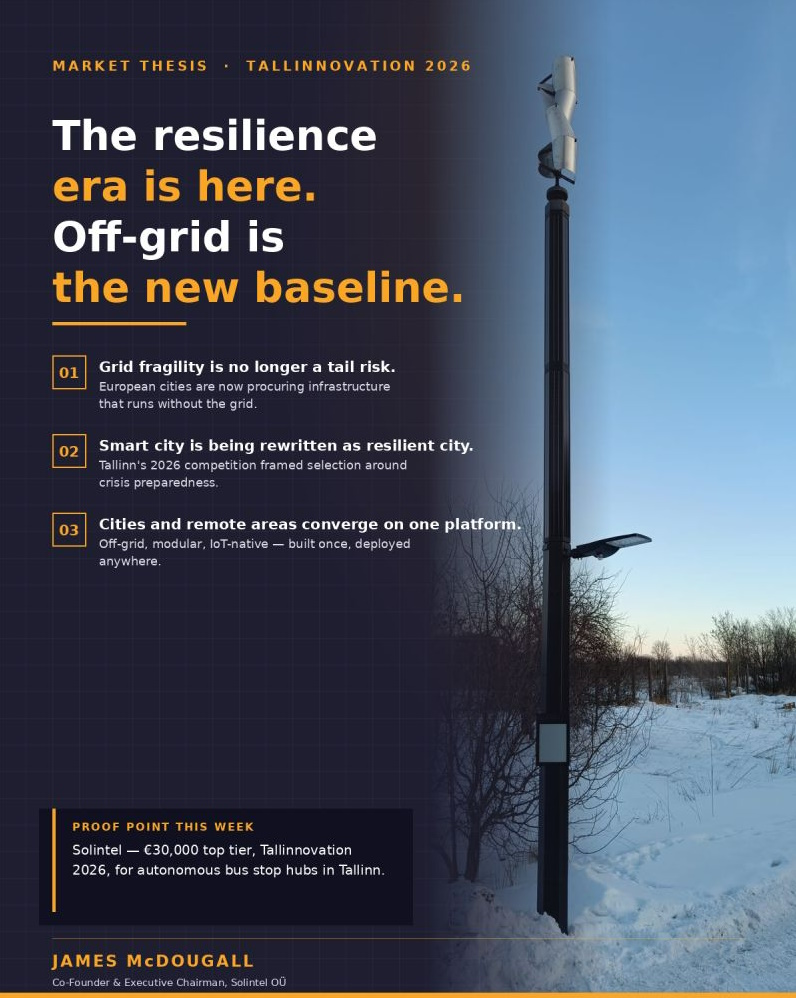
The resilience era is here. Off-grid is the new baseline.
Three things have been true for a while. This week the City of Tallinn put a price tag on all three at once.
- Grid fragility is no longer a tail risk. European cities are now actively procuring infrastructure that runs without the grid — not as a backup mode, but as the default operating mode.
- Smart city is being rewritten as resilient city. Tallinn’s 2026 innovation competition framed selection explicitly around crisis preparedness and continuity of operations. On NATO’s eastern flank, that framing is not academic. It is the new procurement logic, and the rest of Europe is about to follow.
- Cities and remote areas converge on one platform. The same off-grid, modular, IoT-native infrastructure that resilient cities now demand is exactly what defense installations, remote industrial sites, and underserved regions have needed for years. Built once, deployed anywhere.
The proof point this week:
Solintel Ltd was awarded €30,000 — the top funding tier — in Tallinnovation 2026, selected as one of six winners from 27 submissions, to deploy autonomous bus stop hubs across Tallinn. Solar, wind, lithium iron phosphate storage, IoT, real-time e-paper transit display — all running off-grid. No grid connection required.
It is one award in one city. But it is a real signal about where European municipal infrastructure capital is heading next.
Congratulations to Raul Reemet and the entire Solintel Ltd team. And thank you to the City of Tallinn and Tehnopol for the continued partnership.
The next decade of urban infrastructure is being designed right now, in Tallinn. Worth paying attention.